
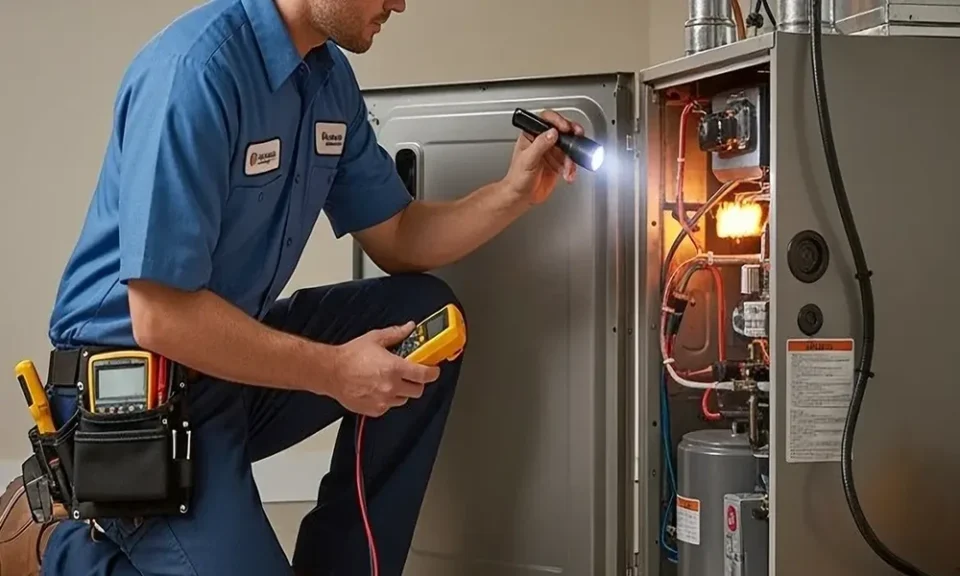
Two thousand dollars. That is what a heat exchanger job ran one of my neighbors, on a furnace that was three winters from the end anyway. She paid it, the thing died in February, and she bought a new furnace on top of the repair bill. Nobody made her a villain about it. She just never asked the one question that matters: am I fixing this, or am I renting it?
Here is the promise. By the end of this piece you will have a simple way to decide repair versus replace, a sense of what the job actually involves, and a list of questions worth asking before anyone orders parts. No scare tactics, no hidden sales pitch, just the math most homeowners never see. If you would rather skip the reading and get a technician on the phone, Peterson Air Care furnace solutions can walk the decision with you in person.
Quick preview. We will cover the repair-or-replace math, the five checks that settle it fast, what a replacement day actually looks like, and how to keep the system you own running longer.
Repair or replace: run the 50 percent rule first
The trade shorthand goes like this. If the repair quote lands above half the price of a new unit and the furnace is already in the back half of its expected life, replacement usually wins. That is the whole rule. Everything else is commentary.
Why does it hold up so well? Because a furnace is a system, not a machine. When one part wears out, the rest of it is wearing at the same pace. A new blower motor dropped into a fifteen year old cabinet buys you a working motor inside a tired shell. You will be back on the phone within two seasons, and this time the technician is standing next to a unit you already paid big money to keep alive.
Watch for the repeat visit pattern too. Two service calls in one winter is a signal. Three is a pattern. And if the failures land on the same subsystem twice, the math tilts hard toward replacement no matter what the calculator says on paper.
Five checks that settle it in one visit
Ask your technician to run through these out loud while you are standing there. Any decent tech will, and you will learn more in ten minutes than an hour of internet reading gets you.
- Age: a furnace in the second half of its service life with a repair bill above half the replacement cost is a replace almost every time.
- Repair history: pull the service stickers off the cabinet. Two or more repairs in two years tells you where this is heading.
- Repair size: a control board or blower is a bigger decision than a thermocouple or igniter. Small parts, small money, repair on.
- Carbon monoxide signs: soot streaks, a yellow lazy flame instead of a crisp blue one, or a CO alarm going off. Shut it down, call a pro, and get the heat exchanger inspected before you run it again. The Consumer Product Safety Commission treats heating equipment as a leading source of home carbon monoxide incidents, so this check is not optional.
- Comfort drift: if certain rooms never get warm no matter what the thermostat says, you may be patching a distribution problem with furnace repairs.
The carbon monoxide item is the one I would never let slide. Everything else has a dollar figure attached. That one has a family attached.
What replacement day actually looks like
A straight swap on an existing setup is usually a one day job. The crew pulls the old cabinet, checks the venting and gas line, sets the new unit, and runs a combustion test before they leave. You get a commissioning report, and you should ask for it. If the installers do not own a combustion analyzer, that tells you something about how they work.
Where it stretches past a day is usually one of three things: the venting is undersized, the ductwork needs a fix, or the new unit uses a different fuel delivery setup than the old one. None of those are surprises a good estimator misses, which is why I ask for the measurement report before signing anything. Sizing by rule of thumb, matching whatever was there before, is how people end up with a furnace that short cycles and never quite feels right.
Sizing, efficiency, and the parts that actually last
Manual J is the standard load calculation for sizing residential heating and cooling equipment. If a contractor skips it and matches the old unit’s capacity, ask why. Oversized furnaces cycle on and off in short bursts, wear their own parts out faster, and leave hot and cold pockets around the house.
On efficiency, the honest answer is that a better furnace saves real money on gas but the payback runs longer than most salespeople imply. The Department of Energy publishes baseline guidance on home heating, efficiency, and how far a high efficiency unit has to run to earn back its price difference in your climate. Read it before you decide between mid range and top tier. For a milder climate, top tier efficiency rarely pays back before the furnace itself is due for replacement.
Here is the part I would spend on instead. The installation quality. A mid range furnace installed with sealed ducts, correct gas pressure, and a proper static pressure test will outlast a top tier unit wedged in by someone in a hurry. The box matters less than the hands that set it.
Keep the next furnace out of your life longer
Most of what kills furnaces is boring. Filters left in too long. A once a year tune up skipped because the system was running fine. Vents blocked by a storage box nobody remembers putting there.
Run through this before each heating season and you are ahead of most homes on your street:
- Swap the filter on schedule, and use the size the cabinet calls for, not the closest one on the shelf.
- Book a tune up in early fall, before the first cold snap fills every company’s schedule.
- Keep the area around the furnace clear, especially the intake and the vent run.
- Write the service date on a sticker on the cabinet. Future you will thank present you.
- Note any new noise, smell, or uneven heating in a phone note. Patterns show up when you write them down.
The one number to remember
Half. If the repair quote crosses half the price of a new furnace, and the unit is well into its service life, stop fixing and start planning. Every dollar past that line is a dollar you will spend again soon anyway, usually at the worst possible time of year, usually in a hurry.
So plan the swap instead of getting surprised by it. Get an inspection, get the sizing done right, and pick the efficiency tier that fits your climate rather than the brochure. Your furnace is a fifteen year relationship. You owe it a better ending than an emergency call in January.
